%20copy%20(1).webp)
Verify workforce capabilities.
Turn your workforce into a competitive advantage. Elo is your AI Skills Agent: verifying real capabilities aligned to your business strategy and connecting development to performance outcomes. Move from insights to action and make every talent investment defensible.
ELO
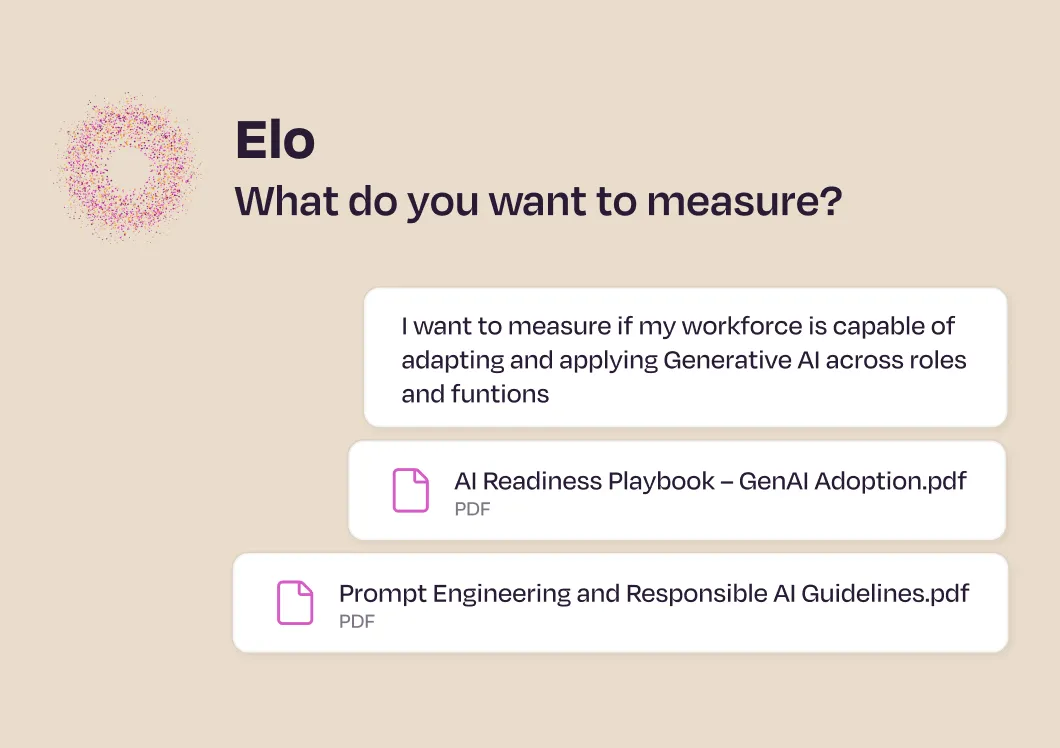
What do you want to measure?
JANE
AI Readiness across my organization
Real-world success story: building AI fluency at scale.
ServiceNow launches Workera enterprise-wide to build an AI-ready workforce
Needed to elevate AI literacy at scale to achieve best-in-class benchmarks, powering a world-class, AI-native tech ecosystem and sustaining competitive advantage through innovation, excellence, and top-tier talent.
Org-wide clarity of current state of workforce AI capabilities, paving the way for targeted upskilling through customized assessments in phase two of launch.
Meet Elo, your AI Skills Agent.
Elo isn’t a chatbot, another dashboard, or just an HR tool. It’s the system that takes ownership of skills verification, end to end.
When questions come up, such as what skills matter, how do we measure them, and what do we do next, Elo handles the work automatically.
From assessment design to insight to action, Elo removes manual setup, reduces guesswork, and keeps skills data decision-ready as your organization evolves.
How Elo works for you.
Replace noisy proxies with a trusted, verified view of workforce capabilities that’s grounded in objective assessment evidence, real proficiency signals, and demonstrated growth over time.
ALIGN
What skills should we be measuring?
Elo brings the right agents together to:
- Turn business priorities into measurable skill programs
- Map skills to roles and job architecture
- Design programs aligned to real operating constraints
Turn strategy into skills without the setup overhead.
MEASURE
Can we trust these skills signals?
Elo brings the right agents together to:
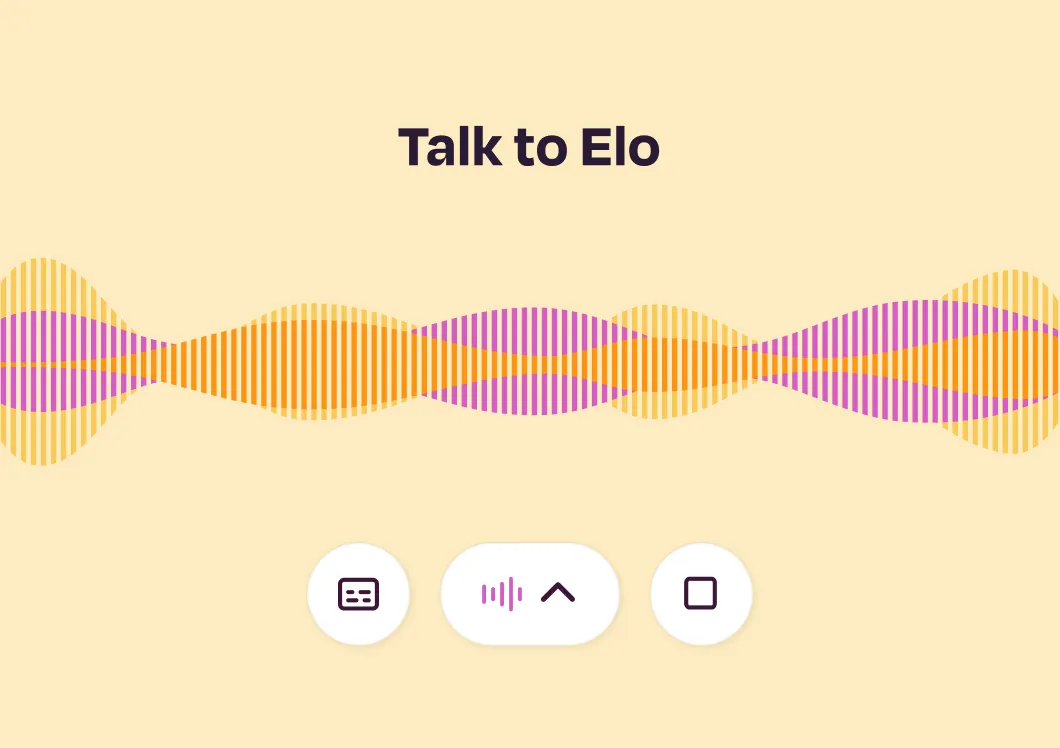
- Create or adapt AI-native assessments for any skill
- Measure real proficiency through conversations, simulations, and job-like tasks
- Validate results with defensible, standards-based evidence
Understand what people can do. No proxies, no guesswork.
ACTION
Now what do we do with this data?
Elo coordinates agents to:
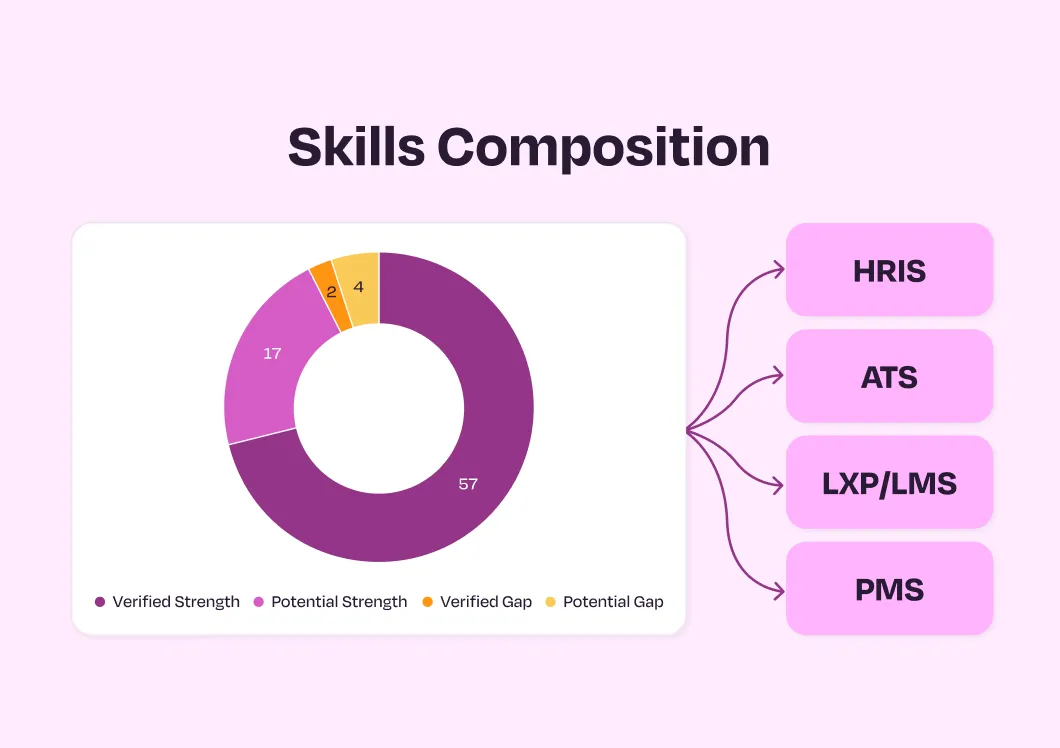
- Identify capability gaps and recommend next steps
- Connect people to the right learning at the right moment
- Deliver a single source of truth with skills data in the flow of your work.
Connect insight to action with decision-grade skills data.
TRACK
What skills do we need to deliver on our business objectives?
Elo brings the right agents together to:
- Connect org-wide skills to strategy
- Track skill growth and learning impact over time to demonstrate measurable ROI
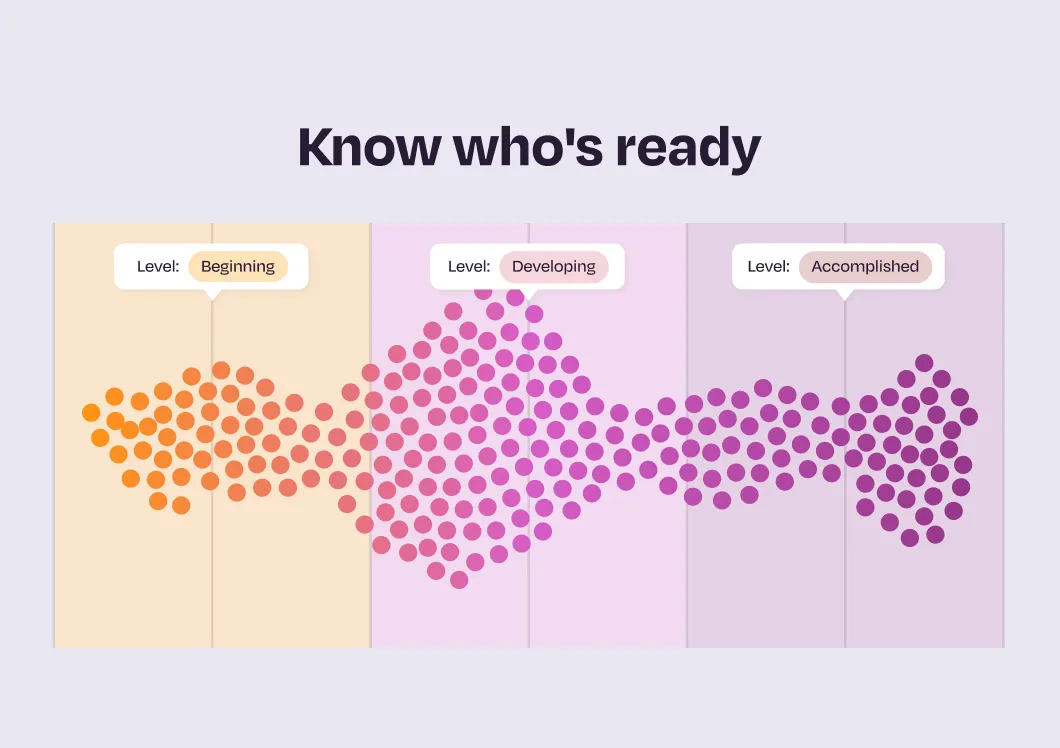
- Benchmark readiness and proficiency by role, function, or region
See progress in motion and adapt as roles and priorities evolve.
Turn insights into momentum, automatically.
This is continuous skills verification. For many organizations, development has become a cost center because it is hard to measure and disconnected from outcomes. Elo changes that by making capability growth visible, comparable, and defensible over time.
Your team gets clarity. Your executives get confidence. You get momentum.
You bring the context. Elo does the work.
Need a custom skills assessment? Done.
Not sure what to measure next? Handled.
Want data you can trust and act on? Covered.
“Workera’s approach represents a shift in how we measure skills — moving from static metrics to real-time skills verification.”

Josh Bersin
Global Industry Analyst
Verify any skill, for any role, at any moment.
At the core of Workera’s Verified Skills Intelligence Platform is a unified measurement system built on Evidence-Centered Design and accelerated by multi-agent generative AI.
Discover the Science that powers Elo.
Learn More

Build your own assessments in minutes
Describe what you want to measure, and Compose, Workera's AI assessment author, builds an evidence-based assessment with you in minutes, then keeps sharpening it after launch.

Start measuring skills from day one
Get started quickly with our globally benchmarked skill assessments built from millions of real-world observations to power trusted, ready-to-launch measurement.
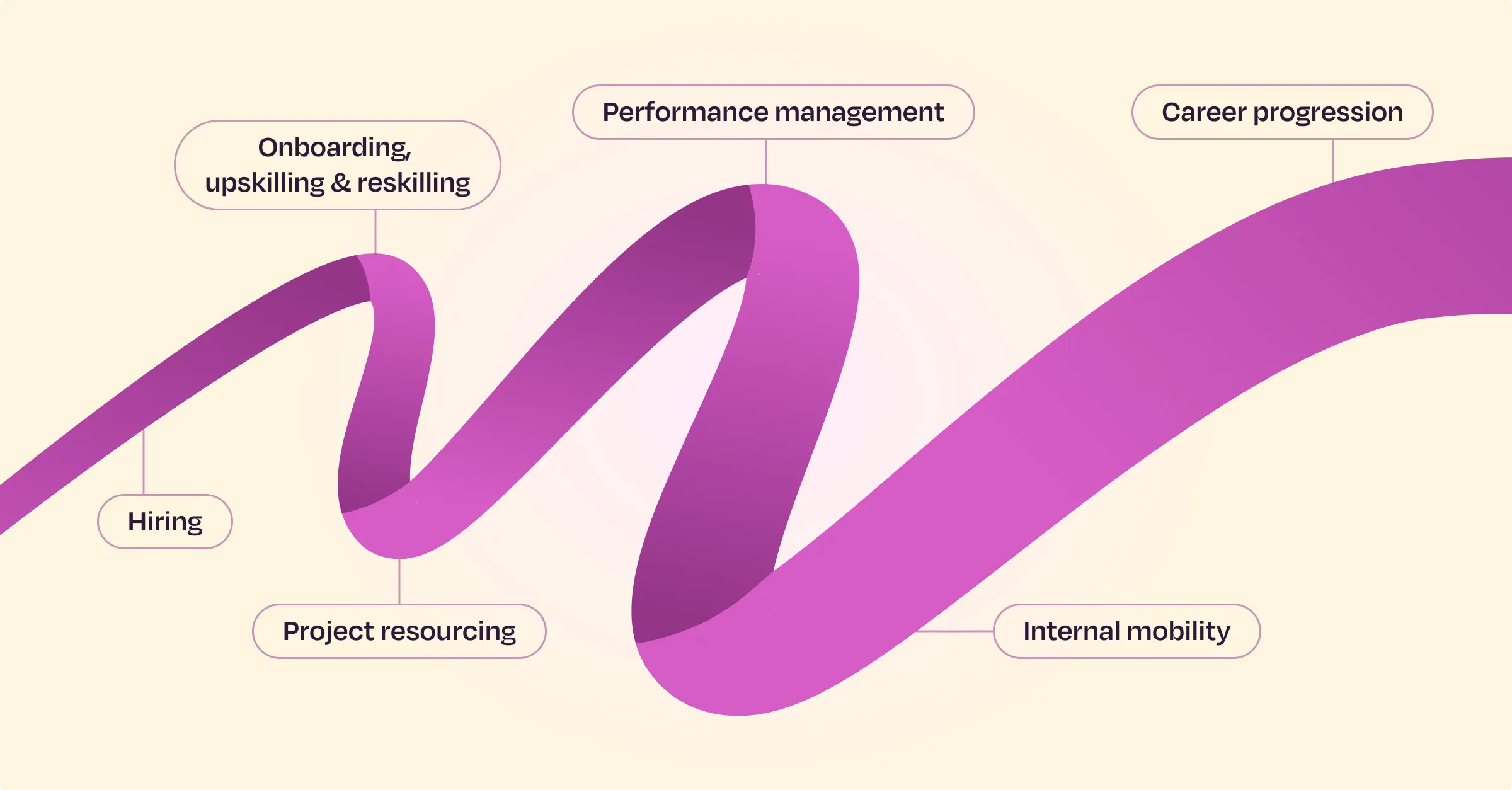
Power every decision across the talent lifecycle.
Every talent decision is only as defensible as the data behind it. With one skills data layer, leaders can move faster, reduce risk, and act with confidence.
Trusted by leading global enterprises.
9M+
Skills verified
across global companies.
Security and compliance
you can rely on.


One skills data layer powering your tech stack.



+ and more
99.99%+
Uptime and monitoring
ensuring reliability.
3X
Faster upskilling
vs one-size-fits-all learning.
White glove support
helping you go further faster.




The one skills signal every leader needs.
Most organizations need a mix of skills signals but when the decision matters, skills verification is what leaders can trust and defend.
Skills inferencing provides directional signal at scale:
Probable skill signals
Directional insights
Population-level trends
Speed and broad coverage
Inferred potential
Skills verification delivers objective evidence you can act on:
Demonstrated proficiency
Decision-grade evidence
Individual-level insights
Accuracy and fairness
Proven capabilities
FAQ
Skills intelligence is the continuously updated system of record, the single trusted place organizations use to understand workforce capability. It captures what skills people have, how strong those skills are, and how those skills map to real business needs across roles, teams, and the full talent lifecycle.
Modern skills intelligence helps organizations understand skills at every point in the talent lifecycle where decisions matter. It brings together AI-based measurement, real work context, and engaging experiences to deliver clear, decision-ready insights across hiring, onboarding, learning, project staffing, readiness checks, and ongoing performance, without slowing down the workforce.
In practice, skills intelligence answers four essential questions:
- What skills do we need?
- What skills do we have and how strong are they?
- What gaps does this leave?
- Where do these gaps exist?
Skills intelligence matters because organizations can’t execute strategy without knowing, accurately and continuously, what their workforce is capable of.
Jobs change faster than titles, AI is reshaping roles in real time, and learning activity alone no longer reflects readiness. Without skills intelligence, leaders are forced to make high-stakes decisions based on outdated assumptions, incomplete data, or surface-level signals.
Skills intelligence provides:
- Confidence, by showing what people can actually do, not just what they’ve been exposed to
- Relevance, by aligning skill signals to real business needs and moments that matter
- Speed, by enabling faster decisions without sacrificing trust
- Resilience, by keeping capability data current as roles and skills evolve
Workera’s approach to skills intelligence is designed to meet these requirements at enterprise scale. Without skills intelligence, workforce decisions are based on belief. With it, they’re based on evidence.
Skills data is considered verified at Workera when it is grounded in demonstrated evidence, not declarations, assumptions, or inference alone. Verification reflects how individuals actually perform against realistic, job-relevant tasks aligned to specific skills.
Within Workera's skills intelligence, verification means that skill signals:
- come from direct application, not self-report
- reflect real work scenarios and role expectations
- are scored using clear, interpretable criteria
- can be compared fairly across people, roles, and time
Because skills are verified this way, leaders can see not only where skills stand today, but how they change over time as people grow and roles evolve. This makes skills intelligence useful for real workforce decisions, such as understanding readiness, planning for future needs, and deciding where to invest.
Verification is what turns skills data into a trusted system of record, rather than a set of one-time results.
Workera measures skills through AI-driven, conversational skill verification designed to capture demonstrated capability, not recall or self-report. Measurement is grounded in job-relevant scenarios that reflect how skills are applied in real work.
Rather than treating measurement as a single event, Workera activates multiple measurement moments over time. Each interaction contributes incremental evidence, allowing skill signals to be interpreted longitudinally rather than inferred from one-off performance.
From a measurement science perspective, Workera focuses on response processes, how individuals reason, and act within realistic, job-relevant scenarios. This produces richer, more interpretable evidence for understanding proficiency and confidence.
Leaders use skills intelligence to reduce uncertainty and make execution-ready decisions. It helps answer questions such as:
- Who is actually ready for this initiative?
- Where are the most critical capability gaps?
- How is readiness changing over time?
Rather than relying on anecdote, role titles, or lagging indicators, leaders gain a shared, evidence-based view of workforce capability. This allows strategy, investment, and execution plans to be grounded in what the organization can truly do today, and what it will be able to do next.