
Five Key Takeaways from ServiceNow’s AI Playbook

Workera Team
Enterprises around the world are undergoing an AI transformation. But some of the world’s leading businesses are already setting the standard — showing what successful AI adoption should look like.
ServiceNow, a global technology company with more than 20,000 employees, recently released a playbook for HR and business leaders, “How to Make AI Work for People,” outlining the best practices for enterprises to optimize their AI efforts (hint: people are, and will remain, at the center).
ServiceNow’s playbook is an incredibly valuable asset, because it offers a path forward for what has until now been a technology with no clear precedent. ServiceNow CHRO Jacqui Canney recently joined Josh Bersin’s podcast to discuss the playbook and ServiceNow’s AI journey.
Here are five key takeaways from ServiceNow’s playbook and Canney’s recent discussion demystifying AI transformations.
1) AI should unleash a “human renaissance”
ServiceNow’s playbook introduces an important reframing: while AI represents a major technological inflection point, its true promise lies in enabling human potential.
As Canney told Bersin, “We believe this moment is a human capital renaissance. If we don’t take it on as leaders — if we don’t help our people navigate it — companies won’t realize the value they hope to get from AI.”
According to the World Economic Forum’s Future of Jobs Report 2025, 86% of employers expect AI and information-processing technologies to transform their business by 2030. AI will automate routine workflows, streamline processes, accelerate decision-making, and generate real-time insights. The result should not be to shrink the workforce — it should be to redirect talent toward more meaningful, strategic, creative, and human work.
For HR and business leaders, this era represents a sweeping opportunity to enable more fulfilling work, to increase organizational capacity without increasing headcount, to move people closer to work that requires judgment, empathy, and creativity, and to reimagine what roles can look like when AI is a collaborator, not just a tool.
2) HR and IT must work closely together
AI transformation cannot be owned by a single function. AI cuts across systems, workflows, teams, and employee experiences, and successful use of AI depends on deep partnership between HR, IT, and business leaders.
ServiceNow’s playbook emphasizes the importance of establishing unified governance, shared accountability, and a common language for how AI will be deployed. Alignment is critical as organizations shift from experimenting with tools to redesigning workflows, roles, and operating models around AI.
Canney echoed this in her conversation with Bersin, describing how ServiceNow’s own AI transformation is powered by a tightly coordinated leadership team: “Our CIO, CTO, product leaders — everyone feels accountable for this transformation. There is no world where HR can do this alone or where IT can do this alone. We’re team captains for each other.”
A collaborative model reflects the reality that AI is as much about people as it is about technology. HR brings expertise in skills, workforce planning, change management, and employee experience, while IT brings expertise in systems, data integrity, infrastructure, and feasibility. Together, they form a unified engine that guides responsible adoption.
When HR and IT operate as co-architects of AI transformation — rather than parallel owners — organizations can move faster, reduce risk, and unlock far more value.
3. Put skills at the center
AI transformation needs to be anchored in skills, not roles. Roles are evolving too quickly and unevenly across enterprises for traditional job descriptions to remain reliable. Skills, however, offer a stable, data-driven foundation for understanding where the workforce is today and what it needs to thrive tomorrow.
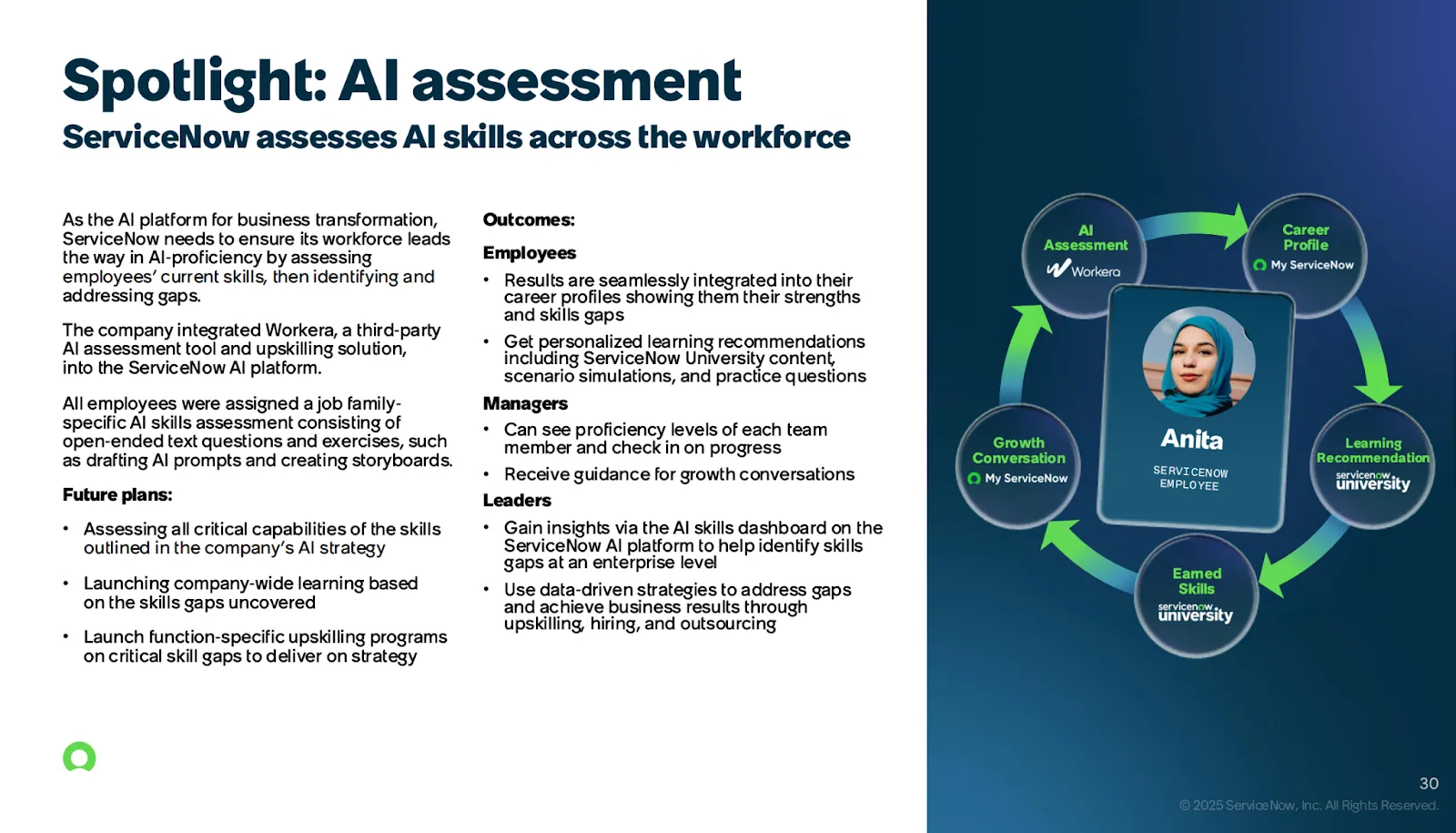
ServiceNow approached this challenge by effectively “X-raying” its workforce: mapping how AI will influence every job, assessing current employee capabilities, and then creating personalized roadmaps for skill development. Of ServiceNow’s verified skills intelligence journey, Canney said, “We assessed everyone — including the board — and created personalized roadmaps for AI capability growth. You can’t transform without real skills data.”
Skills intelligence enables organizations to help employees transition into the future of work rather than feel displaced by it. With clear visibility into what people can do — and what they can realistically learn — leaders can reimagine roles, identify emerging opportunities, and design development programs that are tailored, actionable, and equitable.
This is where many enterprises — including ServiceNow — are turning to Workera. By embedding verified skills assessments into their talent processes, organizations are gaining clarity on which AI skills matter most, which ones should be prioritized, and how to build personalized learning paths at scale.
4) Lead change with storytelling
Amid the technical complexity of AI adoption, ServiceNow’s playbook highlights a powerful, but often underestimated, leadership tool: storytelling. As AI reshapes jobs and workflows, employees inevitably have questions about their futures — questions that require clear, consistent, and human-centered communication.
Canney describes storytelling as the connective tissue of their transformation. She shared, “We [ServiceNow] wrap this entire transformation in constant storytelling — open conversations, listening sessions, celebrations. It’s how you bring people with you.”
A narrative approach helps employees see where the company is heading, why investments are being made, and how AI can support — rather than threaten — their growth.
Storytelling becomes a vehicle for transparency, empathy, and empowerment, helping organizations avoid fear-driven resistance and instead cultivate a culture of curiosity, experimentation, and shared purpose. When grounded in honesty and paired with change management, storytelling transforms AI adoption from a technical rollout into a collective journey that all employees feel involved in. It signals to employees that they are partners in the transformation, not passive observers of it.
5) Push past implementation
AI’s real value begins after implementation. Many organizations stop at deploying tools, upgrading systems, or rolling out training — but these steps only prepare the ground for the hard work to follow. Transformation happens when companies reallocate capacity, redesign work, and reimagine the employee experience.
ServiceNow’s own journey illustrates this shift. Once AI took on the routine, transactional activities within their People Operations team, they reinvested that capacity into deeper, more human work — like complex cases, advisory support, and high-value employee interactions. As Canney shared, “We didn’t stop once AI automated the routine work. We reinvested people’s time into higher-value work. That’s where the transformation happens.”
AI adoption becomes meaningful when it leads to new ways of working. This requires leaders to revisit job architectures, rethink team structures, and consider how AI agents can partner with humans to expand — not simply replace — capability.
Pushing past implementation also demands ongoing governance, measurement, and iteration. Leaders must evaluate which workflows are ready for redesign, assess where capacity has been created, and continuously refine how human and AI contributions combine to drive business outcomes.
Successful AI transformations are human transformations
ServiceNow’s AI playbook underscores what HR and business leaders across industries are beginning to recognize: AI transformation is fundamentally a people transformation.
The organizations that will lead the next decade are those that treat AI as a catalyst for a human renaissance, build deep partnerships between HR and IT, anchor change in verified skills intelligence, lead with transparency, and push beyond technology deployment.
Interested in learning more about how your business can make your AI transformation work best for your workforce and customers? Read ServiceNow’s playbook for clear next steps. Schedule a demo with Workera to see how verified skills intelligence can set a foundation for the journey.
Category
Blog
Trending Updates

Blog
L&D Doesn't Need a "Seat at the Table." It Needs Real-Time Capability Intelligence.

Blog
AI Disclosure in Talent Assessment: What Article 50 Requires Now, and What’s Coming in 2027

Blog
The Board Isn’t Asking If Your People Use AI. It’s Asking If They Can Do the Work.