Eliminate the Language Barrier to Global Talent Intelligence: How AI-First Translation Unlocks True Global Talent Intelligence

Workera Team
For years, global enterprises have accepted a frustrating reality: workforce skills data is inherently uneven across regions. Not because employees lack capability, but because organizations have been measuring technical skill through the lens of language proficiency.
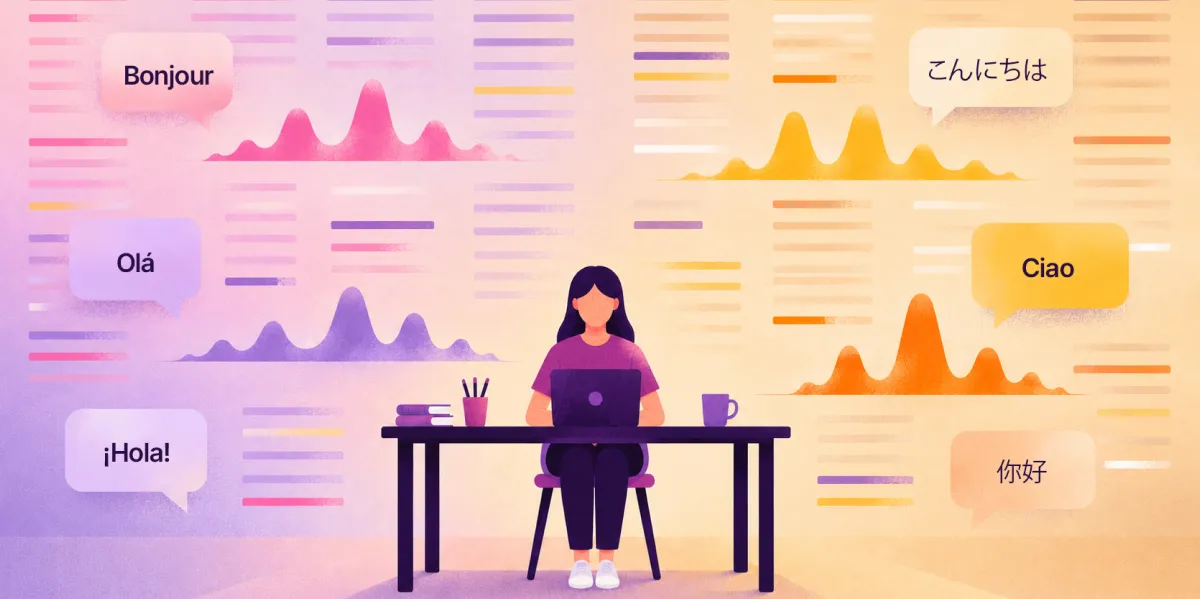
An engineer in Tokyo might deeply understand cloud architecture but struggle with timed English questions. A cybersecurity analyst in Paris might know how to neutralize a threat, yet lose confidence translating technical nuances under pressure. In São Paulo, a high-potential employee underperforms not from a lack of expertise, but from the cognitive burden of operating in a second language.
This is the “language tax,” the invisible penalty paid when companies assess technical mastery in a language that isn't the employee's native tongue. For enterprises, this tax results in distorted talent data, blind spots in workforce planning, and stalled global talent decisions.
Historically, organizations attempted to solve this problem through traditional localization. But manual translation workflows are expensive, slow, and impossible to scale at the speed modern businesses require. By the time assessments are localized, the business priorities have often already shifted.
AI-first translations represent a fundamental shift for workforce intelligence. Instead of treating language accessibility as a long-term localization project, organizations can now deploy skills assessments, learning experiences, and workforce benchmarking globally in near-real time so that every employee can participate in their preferred language from day one.
At Workera, our philosophy is simple: a language barrier should never obscure technical mastery.
The End of Translation Lag
Traditional enterprise localization was built for a different era. A company would launch a new skills initiative in English, then wait months for regional versions to be translated, reviewed, approved, and deployed. During that delay, global teams were left out of workforce planning conversations, assessment rollouts, and development opportunities. Leadership teams operated with incomplete visibility while employees outside English-speaking markets experienced a fragmented learning experience.
In fast-moving environments — especially around innovative technologies like AI, cybersecurity, data, and cloud infrastructure — that delay is no longer sustainable.
AI-first translation changes the equation entirely. Instead of relying on slow, manual localization cycles, organizations can instantly provide broad accessibility across assessments, learning content, and platform experiences. Workera’s AI-first translation layer enables enterprises to launch locally and globally at the same time, which dramatically reduces operational friction and accelerates workforce initiatives across regions.
The operational impact is significant. Organizations can:
- Roll out workforce assessments simultaneously across international teams
- Benchmark skills globally without waiting for regional localization
- Accelerate hiring and staffing decisions across markets
- Launch upskilling initiatives in weeks rather than quarters
For CLOs and L&D leaders, this eliminates one of the biggest bottlenecks in enterprise learning operations: the gap between strategy creation and global execution.
Fair Skills Data Requires Native-Language Experiences
Beyond speed, the real value of AI-first translation is data integrity. Assessing employees in a secondary language measures linguistic fluency rather than technical expertise. This yields unreliable skills intelligence, driving flawed business decisions.
Workera’s AI-first translation approach is built around the principle that employees best demonstrate competence in their preferred language. By removing the cognitive burden of real-time translation, organizations gain a much clearer understanding of true workforce capability.
For employees, it creates a more equitable path to advancement. Workers can demonstrate actual mastery instead of struggling through linguistic hurdles during high-stakes assessments. That improves confidence, participation, and trust in the development process.
For managers, it creates cleaner data for coaching and workforce planning. Leaders can distinguish between a technical gap and a misunderstanding caused by language friction. That leads to more targeted mentorship, accurate promotion decisions, and stronger global teams.
For leadership, it transforms workforce visibility. Instead of fragmented regional data sets distorted by language barriers, organizations gain a unified view of skills across the enterprise. That enables more confident hiring, internal mobility, succession planning, and resource allocation decisions.
In short, equitable assessment experiences create more accurate talent intelligence, and more accurate talent intelligence creates better business outcomes.
From Regional Silos to a Unified Global Workforce
Most multinational companies operate with hidden workforce silos, including language silos.
Skills data collected in one region often cannot be meaningfully compared with another because assessment participation, comprehension, and confidence levels vary dramatically across languages. That makes it difficult for enterprises to understand where expertise actually exists inside the organization.
The result is a workforce that appears fragmented even when the talent itself is not. AI-first translation helps solve this by standardizing accessibility across the enterprise. When employees across Tokyo, Paris, New York, and São Paulo can engage with the same assessments and learning experiences in their preferred language, organizations can finally aggregate talent intelligence at a global scale.
Historically, mapping global capabilities equitably was nearly impossible. With AI translation, leadership teams can discard biased assumptions about regional talent pools. Instead, they can surface hidden internal experts, deploy skilled talent to critical initiatives faster, and assemble cross-border teams based on verified capability rather than geographic location.
This is especially important as companies scale AI transformation initiatives worldwide. Organizations don’t necessarily need the largest talent pools to succeed; they just need to know who they have, what they can do, and where they’re located.
The Future of Skills Intelligence is Borderless
Global enterprises cannot afford workforce intelligence systems that only work effectively for English-speaking employees. As AI accelerates the pace of change across industries, organizations need faster ways to identify capability gaps, mobilize talent, and scale learning initiatives worldwide. That requires skills intelligence infrastructure designed for operational speed, equitable experiences, and global accessibility from the start.
When language is no longer a barrier, organizations gain a trustworthy view of workforce capability across the entire enterprise.
That’s the future Workera is building — helping organizations unlock accurate, equitable, and scalable talent intelligence in any language, across any workforce. Schedule a demo to learn how Workera can enable true skills intelligence for your team.
Category
Blog
Trending Updates

Blog
L&D Doesn't Need a "Seat at the Table." It Needs Real-Time Capability Intelligence.

Blog
AI Disclosure in Talent Assessment: What Article 50 Requires Now, and What’s Coming in 2027

Blog
The Board Isn’t Asking If Your People Use AI. It’s Asking If They Can Do the Work.