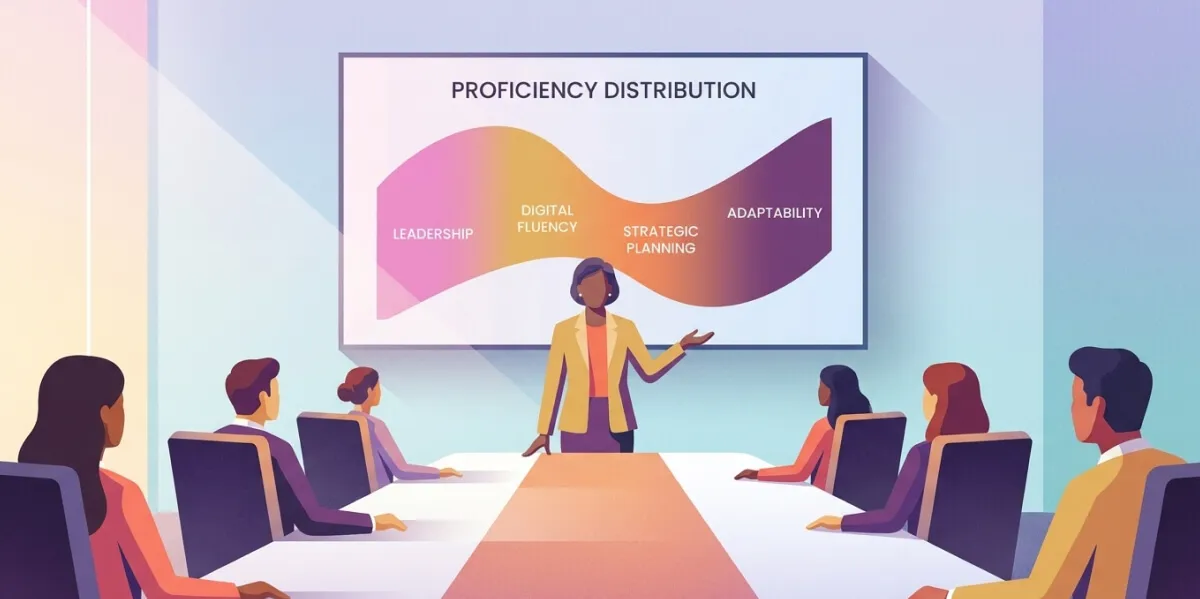
The CHRO's Boardroom Blueprint: Presenting Capability Metrics Instead of Headcount

Workera Team
Shifting the Boardroom Narrative from Capacity to Capability
When CHROs step into the boardroom to discuss strategic execution, a persistent disconnect often occurs. While the Board and CEO ask whether the business has the agility to execute next year's strategic pivots, HR has traditionally responded with operational volume metrics: open requisitions, time-to-fill, turnover rates, and aggregate FTE headcount.
Headcount measures capacity, not capability. Knowing you have 5,000 engineering FTEs tells executive leadership nothing about whether those engineers possess the verified skills to deploy generative AI pipelines, modernize legacy architectures, or secure cloud infrastructure.
To cement HR as an indispensable strategic driver, CHROs must evolve the boardroom narrative. That means moving away from static headcount reports and presenting verified workforce capability metrics.
The Executive Mandate: Output Over Headcount
The pressure to rethink talent reporting is coming directly from the top.
- The Productivity Mandate: Research from Gartner reveals that 86% of CEOs plan to rely on technology and AI to drive revenue growth, even as spending on traditional headcount expansion slows. Boards are demanding higher output and operational throughput without simply inflating payroll.
- The Transformation Bottleneck: According to the World Economic Forum, skills gaps are now cited as the single largest barrier to enterprise business transformation worldwide, with nearly 60% of the global workforce requiring substantial reskilling to keep pace with technological change.
- The ROI Disconnect: Gartner benchmark data shows that while 74% of HR leaders agree the enterprise must shift to a skills-based model, half struggle to demonstrate tangible ROI to executive leadership.
When CHROs bring unverified resume data or course completion rates to the C-suite, it reinforces the perception of HR as a cost center. To bridge this gap, leaders need decision-grade capability data.
The Three Capability Metrics to Bring to the Board
To align talent strategy directly with business value, replace vanity metrics with three core capability indicators.
1. Verified Readiness Index
- The Old Metric: "We hired 50 Data Scientists this quarter."
- The Boardroom Metric: "82% of our analytics organization possesses verified proficiency in modern data engineering, up from 54% last quarter."
- Why It Matters? Moving from resume claims to objective, verified capability signals gives executive leaders an audited view of operational risk before launching new business initiatives.
2. Capability Velocity
- The Old Metric: "Employees logged 10,000 hours in AI training."
- The Boardroom Metric: "Our average time-to-proficiency for critical AI workflows dropped from 90 days to 22 days."
- Why It Matters? McKinsey research shows that organizations dynamically mapping and baselining skills increase their speed to acquire critical capabilities by 200%. Capability velocity proves how fast your workforce can adapt when market conditions shift.
3. Capability Allocation
- The Old Metric: "We invested $12M into AI upskilling.”
- The Boardroom Metric: "We closed 64% of our critical AI capability gap this quarter, with measurable gains in AI-enabled productivity, adoption, and quality."
- Why It Matters? Every strategy creates demand for capabilities. The workforce represents the available supply. Measuring gap closure shows whether the organization is building the capabilities required to meet strategic demand and whether those gains are translating into measurable business outcomes.
How to Lead Your Next Boardroom Discussion
Transforming your reporting strategy does not require an immediate overhaul of your entire HR tech stack. CHROs can initiate this pivot in three operational steps.
- Stop Reporting Course Completions: Frame learning investments through capability acquisition rates rather than hours spent in software portals.
- Audit High-Stakes Roles First: Focus skill verification strictly on the top 10 to 15% of roles that drive disproportionate business value, avoiding the trap of trying to map thousands of idle skills at once.
- Connect Capability Gaps to Revenue Risk: Show the direct financial impact of skill deficits, such as delayed product launches or misallocated software licenses, to ground talent discussions in business performance.
By shifting the conversation from how many people you have to what your workforce is objectively capable of executing, the CHRO becomes the primary architect of enterprise agility.
Category
Blog

Trending Updates

Blog
The AI Productivity Paradox: Why High Usage Isn't Delivering Transformation

Blog
Beyond the Copilot: Why "Systems of Intelligence" Require Precision Skills Data
News
Pearson Agrees to Acquire Workera, a Pioneer in AI-Native Enterprise Assessment and Skills Verification