The Future of Workforce Intelligence is Multilingual

Workera Team
For decades, enterprise talent was bounded by geography. Workforce planning was restricted by borders, localized business units and native languages. Even global organizations still fundamentally viewed talent through a fragmented regional lens.
But modern work doesn't recognize borders. The massive rise of remote and hybrid operations permanently redistributed expertise across the globe. Today, a machine learning engineer in Amsterdam collaborates daily with a product team in Silicon Valley, a cybersecurity lead in Toronto, and a data scientist in Buenos Aires. Talent is now completely geographically agnostic.
Yet despite this transformation, workforce intelligence systems are still constrained by language and geography. A native English speaker isn’t more competent than someone who speaks English as a second language; the language itself is simply the interface humans use to express expertise. Too often, enterprises mistake fluency in a dominant business language — usually English — for actual technical mastery. As a result, organizations continue to make hiring, development, and mobility decisions based on incomplete signals.
AI-first multilingual intelligence is reshaping the way enterprises understand talent by changing how workforce capability is mapped, interpreted, and connected across borders. The future of work is multilingual, context-aware, and it doesn’t recognize boundaries on a map.
The No-boundary Workforce is Already Here
For global enterprises, the biggest workforce shift of the last decade is not simply remote work, but the collapse of geographic constraints around talent.
The best person for a role may no longer sit near headquarters or even in the same hemisphere. Critical expertise now exists across distributed markets, emerging economies, and previously underrepresented talent ecosystems. Organizations that can identify and mobilize those skills fastest have a significant competitive advantage.
Most companies still lack a reliable way to see global capability clearly. Traditional workforce systems create invisible blind spots because they depend heavily on language standardization. Employees who are less comfortable operating in English often participate less frequently in assessments, score lower on benchmarks, or struggle to fully demonstrate their expertise in high-pressure environments.
The result is a highly distorted map of enterprise talent. When workforce intelligence is skewed by linguistic fluency, organizations remain blind to their own internal capabilities and systematically underestimate entire regional populations of expertise.
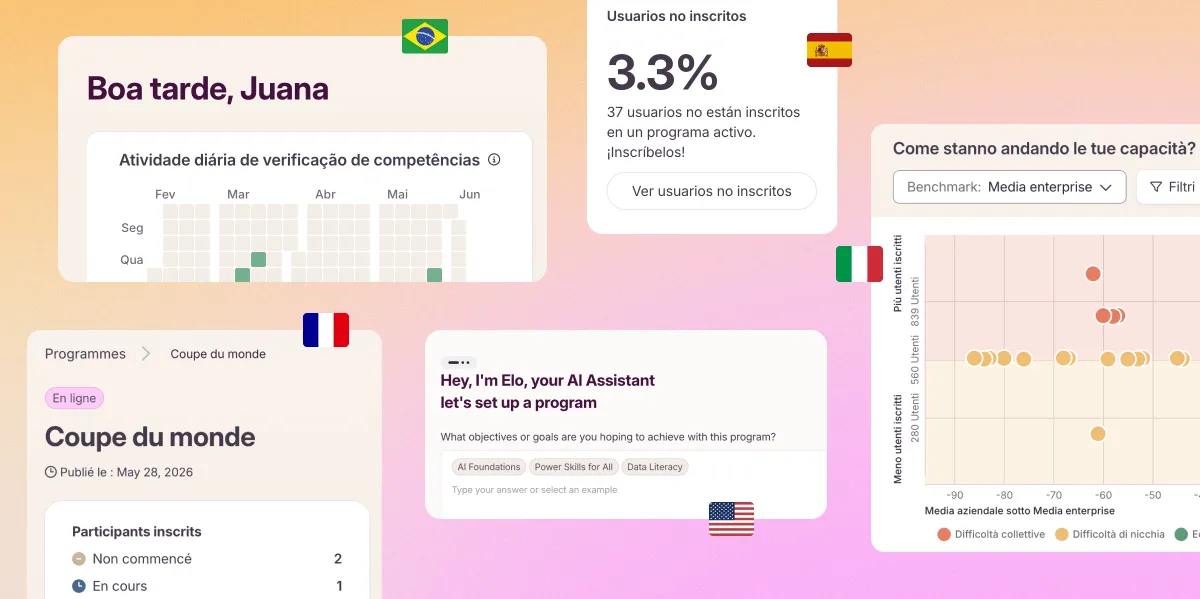
Multilingual workforce intelligence is the infrastructure required for truly global workforce visibility. Workera’s AI-first translation layer was built around this idea: technical capability should be measurable independent of native language. By enabling employees to engage with assessments and learning experiences in their preferred language, organizations can surface talent everywhere it exists, not just where language fluency makes it easiest to identify.
In the emerging workforce economy, the companies that win will not be the ones with access to the most talent. They will be the ones with the clearest visibility into global capability.
The Future is Context Aware
Early conversations around workplace translation focused on accessibility: how do we make systems usable in more languages?
But the next frontier is much more complex. The future of workforce intelligence isn’t about translating words one-for-one, but rather translating context, intent, and skills equivalency across global environments.
Take a Python developer in Tokyo completing a skills assessment in Japanese. Traditionally, that data point remains trapped inside a regional silo, completely invisible to global resourcing managers. AI-driven intelligence changes that. It recognizes that this engineer's verified proficiency aligns perfectly with an enterprise AI pilot being staffed in Berlin, or a cloud modernization sprint launching in New York.
The system no longer sees language as the defining structure of talent. It sees underlying capability.
This is a profound shift. Historically, enterprises built workforce systems around static taxonomies tied to specific regions, job architectures, or languages. But AI-first systems are increasingly capable of understanding semantic equivalency across contexts. They can recognize that technical mastery expressed in French, Japanese, Portuguese, or English represents the same underlying skill signal.
Instead of organizing talent around linguistic or regional silos, enterprises can begin operating from a universal capability layer, one that dynamically connects expertise across teams, countries, and business functions. Language barriers become operational friction, not structural limitations.
Building a Universal Skills Language
The next evolution of workforce intelligence is the emergence of a multilingual skills ontology — a universal framework for understanding human capability independent of language.
Enterprises are severely bottlenecked by data fragmentation: different regions describe skills differently, teams use clashing terminology, and job architectures vary widely by geography. Without a shared framework running underneath your systems, benchmarking global capabilities accurately is impossible.
AI changes that. Workera’s approach to AI-first translations is not simply about creating localized interfaces. It is about building the connective tissue that allows organizations to interpret skills consistently across an increasingly global workforce.
At its core, this means creating a unified layer where capability signals remain standardized even when employees interact with the system in entirely different languages. A cloud engineering capability demonstrated in Spanish should map identically to the same capability demonstrated in Korean. A cybersecurity benchmark completed in French should carry the same workforce intelligence value as one completed in English. The grammar is different; the competence isn’t.
That consistency becomes the foundation for more intelligent workforce planning. Leadership teams can understand aggregate capability across the enterprise, identify emerging expertise regardless of geography, and allocate talent based on verified mastery instead of fragmented regional proxies.
Over time, this universal skills layer becomes increasingly strategic. It enables organizations to move beyond static job titles and toward a dynamic understanding of what their workforce is actually capable of doing in real time.
In an AI-driven economy where skills evolve faster than organizational structures, that visibility becomes one of the most valuable assets a company can possess.
Workforce Intelligence without Borders
As AI continues reshaping the labor market, organizations will need systems that can identify expertise anywhere, connect talent fluidly across borders, and understand workforce potential independent of linguistic constraints.
The companies that embrace this shift early will gain access to a truly global talent advantage: the ability to see, develop, and deploy capability wherever it exists.
At Workera, we believe that starts with removing language as a barrier to understanding human potential. Because the organizations that thrive will be the ones that can finally speak the universal language of skills. Schedule a demo with Workera to learn more.
Category
Blog
Trending Updates

Blog
L&D Doesn't Need a "Seat at the Table." It Needs Real-Time Capability Intelligence.

Blog
AI Disclosure in Talent Assessment: What Article 50 Requires Now, and What’s Coming in 2027

Blog
The Board Isn’t Asking If Your People Use AI. It’s Asking If They Can Do the Work.