Skills Verification Framework: What to Measure and How
About This Conversation
In this conversation, Dani Johnson from Red Thread Research and Taylor Sullivan from Workera dig into one of the most underexplored challenges in the skills space: verification. What does it actually mean to know whether someone has a skill — and how do you decide which skills are worth verifying rigorously versus directionally? The conversation covers the difference between inference and verification, how to build a skills priority matrix, the half-life problem for fast-changing skills like AI, and what high-quality skills data actually looks like when decisions that affect people's careers are on the line.
Speakers
Dani Johnson is co-founder and principal analyst at Red Thread Research, where she leads studies on learning, skills, and people analytics. Her recent research explores how organizations can verify skills and use AI responsibly to make better talent decisions. She is known for bringing an evidence-based perspective to what actually works in skill verification.
Taylor Sullivan is VP of Product and Assessment at Workera, where she has been pioneering AI-native skill assessments that deliver verified skills intelligence. With over fifteen years of experience as an industrial-organizational psychologist rooted in psychometrics, she has shaped modern approaches to ethical, scalable, and adaptive measurement.
Why Measuring Skills Has Always Been Hard (Until Now)
Verification — actually measuring a skill versus inferring it from a resume, degree, or area of study — has historically been expensive, time-consuming, and technically demanding. You need expertise in psychometrics, measurement, or learning design to do it well. AI has dramatically changed the equation: it speeds up the time it takes to create a high-quality assessment and allows that assessment to be contextualized to a specific skill set, the person's role, their experience level, the company, the industry, and the moment in time. The definition of assessment itself has broadened enormously, and a lot more is now possible because of AI.
Inference vs. Verification: The Engineer vs. The Scientist Debate
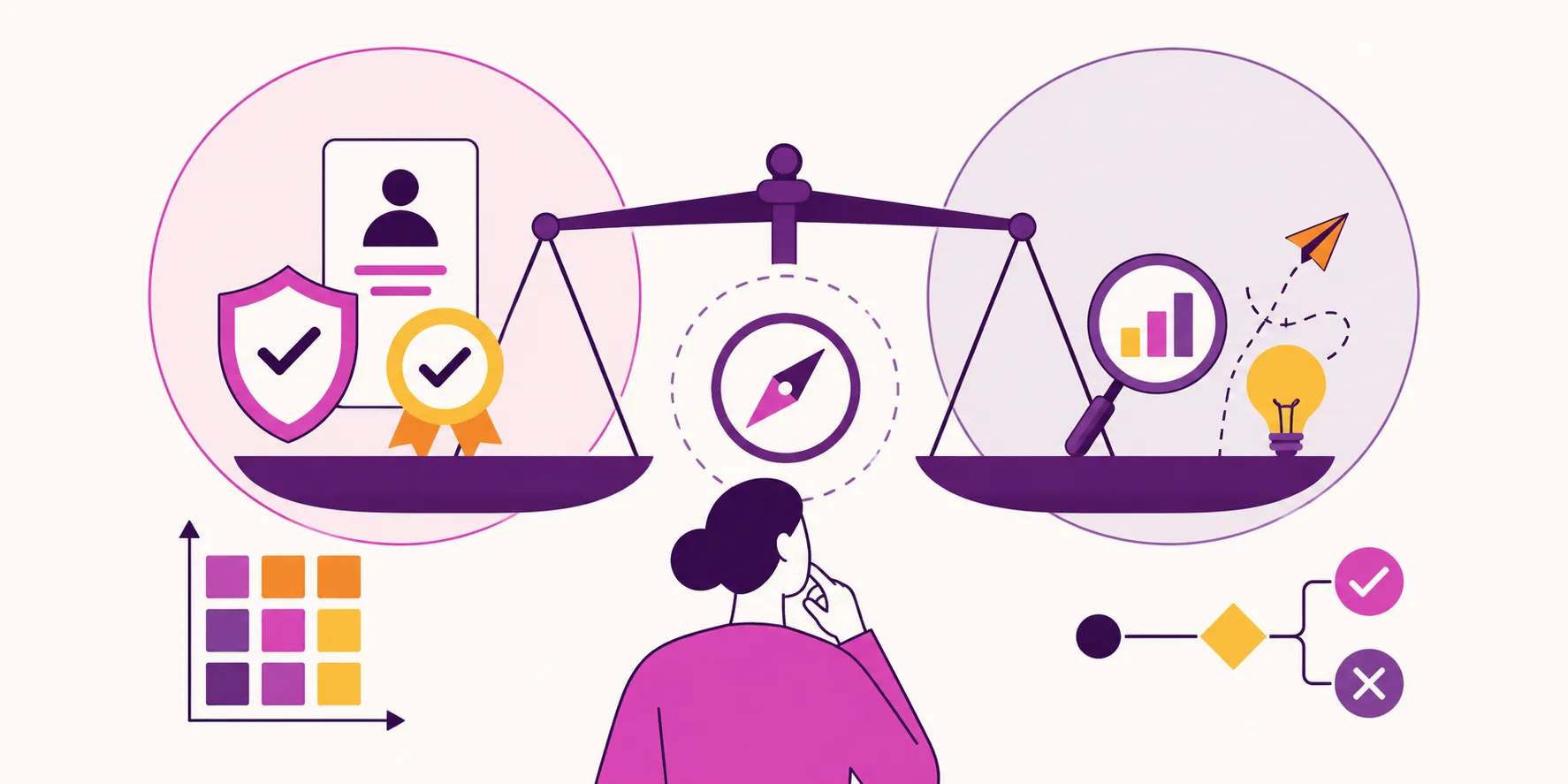
Inference — getting close enough to make a decision based on data streams about how someone has performed on tasks — works well in many organizational contexts. Verification means actually measuring the skill directly. The distinction matters because the quality required depends entirely on what decisions are being made. Triangulating across multiple signals (veracity, volume, and variety) can give a strong enough skill signal for many organizational needs. But for decisions that directly affect someone's career, pay, or role — that's when the rigor of true verification becomes essential.
The Skills Priority Matrix: Where to Put Your Verification Budget
Not every skill needs to be verified with the same level of rigor. A four-square matrix helps organizations prioritize: high business importance vs. low business importance on one axis, and low confidence needed vs. high confidence needed on the other. Low confidence needed means directional guidance is sufficient — you're making investment decisions about what skills to develop. High confidence needed means you're moving someone into a role, hiring, or promoting — the measurement needs to be solid. The upper-right quadrant (high importance, high confidence needed) represents your strategic priorities. Those are the skills where organizational resources and investment should be concentrated.
The Half-Life Problem: How Do You Measure Skills That Change Every Six Months?
In traditional measurement, you'd only invest in measuring predictor variables that were reliable and stable over time. But the half-life of skills is now much shorter. Math skills remain stable. AI skills, prompt engineering, and similar fast-changing domains are points-in-time — and what you're actually measuring is whether someone is invested in learning those skills. At Workera, every skill domain has a half-life associated with it: some are checked every two months, some every six, some annually. The cadence is driven by external monitoring of how stable the skill domain actually is — coupled with awareness of major market trends and technology breakthroughs that might shift the domain entirely.
High Stakes vs. Low Stakes: When Skill Data Quality Really Matters
The most important question for determining what quality of skills data you need is: to what extent does this decision affect the individual? Broad-brush investment decisions can tolerate directional data — sixty to eighty percent accuracy is fine if you're personalizing a learning experience. But if the decision affects someone's pay, succession plan, or role in a workforce restructure, you need a high-quality, defensible data set. These are legally vulnerable decisions. If the system or data were challenged, they often end up in settlements. The threat of legal action is real, and the standard of care for the data needs to reflect that.
Skill Velocity: It's Not Just the Gap — It's How Fast You Close It
Two people may have the same skills gap, but what matters is the slope of the line — how fast each person is closing that gap. For many organizations, velocity is as important as the delta. Every day someone is in a role with a gap in place, there is a cost. The goal from an L&D perspective is to find the most efficient ways to achieve higher-velocity gap closure, giving employees as much agency as possible to close gaps on their own. AI is particularly valuable here — most people, when they have a question or want to build a skill, will go directly to their LLM of choice. That immediacy removes the traditional friction of waiting for the next cohort, the next course, or the next scheduled program.
Inside a 28,000-Employee Company: Real AI Skills Rollout
A global software leader with approximately twenty-eight thousand employees — one that is publicly committed to being AI-ready — took a hard look at its own talent base and asked: are we as AI-ready as we actually need to be? They rolled Workera out enterprise-wide on the same day, to twenty-eight thousand users across twenty countries, focused on AI literacy programming. For more technical roles, they also deployed advanced AI and technical domain content. Within the first week, twenty-five percent of the employee base had taken meaningful action on the platform. Within the first twenty-four hours, eight thousand people had already completed their first baseline assessment. Within a couple of months, they reached a seventy percent activation rate — with a goal of ninety percent — and they're on track. The data is now being used in board conversations and C-level discussions around workforce capability and where gaps exist.
Trending Updates

Skills Intelligence: How to Measure AI Workforce Readiness