Introducing Reassessments: Prove Capability Actually Moved

Workera Team
Measure employees again on an equally rigorous variant, so a change in score is a real change in capability.
Every program is built to grow capability and is eventually asked to prove it did just that.
Most cannot. In 2010, the Association for Talent Development and the ROI Institute asked Fortune 500 CEOs what they wanted from learning investment. Almost all of them wanted to see business impact. Eight percent were getting it. Three quarters wanted return on investment. Four percent had it.
Ten years later, the number has barely moved. In TalentLMS research published this year, 37% of companies say they measure learning by business impact. LinkedIn's 2026 talent research puts it more bluntly: 86% of organizations say they cannot clearly see the skills they already have.
What gets reported instead is attendance, satisfaction, and completion rate. Those numbers describe activity. None of them describe whether the skill moved.
Attendance, satisfaction, completion rate. Those numbers describe activity. None of them describe whether the skill moved.
The obvious fix is to measure before and after. In practice, that is where it falls apart. Use the same assessment twice and memory shapes the second score. Use a different one and the two scores were never comparable to begin with.
Reassessments, now available within the Workera platform, are built for that exact failure. This set of features measures the same participant on the same capability more than once, and every attempt serves a different but equivalent variant, so the two scores genuinely compare. Here is why that last part is harder, and more important, than it sounds.
Measuring twice is harder than it sounds
Hand someone the same assessment a second time and the score is shaped by memory. A higher number might mean the person learned something, or it might mean they remembered the questions. There is no way to tell those apart, which means there is no way to defend the result.
So most tools do the next most obvious thing. They draw a different set of questions from a pool, or serve an adaptive sequence, and call it a second attempt. That solves the memory problem and introduces a bigger one. A different assessment is not automatically an equivalent one. If the second form happened to be easier, the score rose for reasons that have nothing to do with the person answering it. If it was harder, real growth disappears. Either way, the two numbers do not compare, and the before-and-after leadership asked for does not exist.
Comparability is the hard part. It is also the only part that makes a before-and-after mean anything.
Workera does the hard part, not you
This is the distinction that matters when a number gets challenged, and it is work we take on so your team doesn’t have to.
Before variants go live, we confirm they are equally rigorous. Every variant is built to the same blueprint as the baseline and checked against it on four dimensions: predicted difficulty within a tight margin of the base form, every skill covered by at least the same number of questions, a matching mix of question types, and total length within roughly twenty percent of the original.
We keep monitoring them in use. Once a variant is live, we compare how people actually score on it against the base form, alongside completion time, participant feedback, and quality signals such as appeals and drop-off. Any variant that drifts gets flagged.
We show you the complete attempt history behind every score. Every attempt is retained: question results, skill ratings, and a capability score per attempt, charted over time. The highest achieved score leads, and the full record sits on the participant profile and in reports.
Equivalence is judged for the assessment as a whole rather than question by question, because across an entire pool of questions, small differences even out. And for high-stakes use, your own subject matter experts can review any variant before it is administered. Our pre-launch checks run on English variants, so for a high-stakes decision in another language we recommend the same SME review on the translated form. Nothing here is a black box.
Plenty of platforms can serve a second form. Very few will show you that the two forms were parallel.
Why Use Reassessments?
- Report ROI, not attendance. Show measured skill gain by program and by cohort, instead of completion rates and satisfaction scores.
- Trust every variant. Every variant the platform generates is built to be equally rigorous, monitored in use, and backed by complete attempt history.
- Staff based on current capability. Place, promote, and redeploy on a number measured after the reskilling, not before it.
- Re-measure as the work changes. Refresh the baseline each cycle, so the number stays current as roles and AI tools shift underneath them.
How it runs
Reassessment works in three stages inside a program.
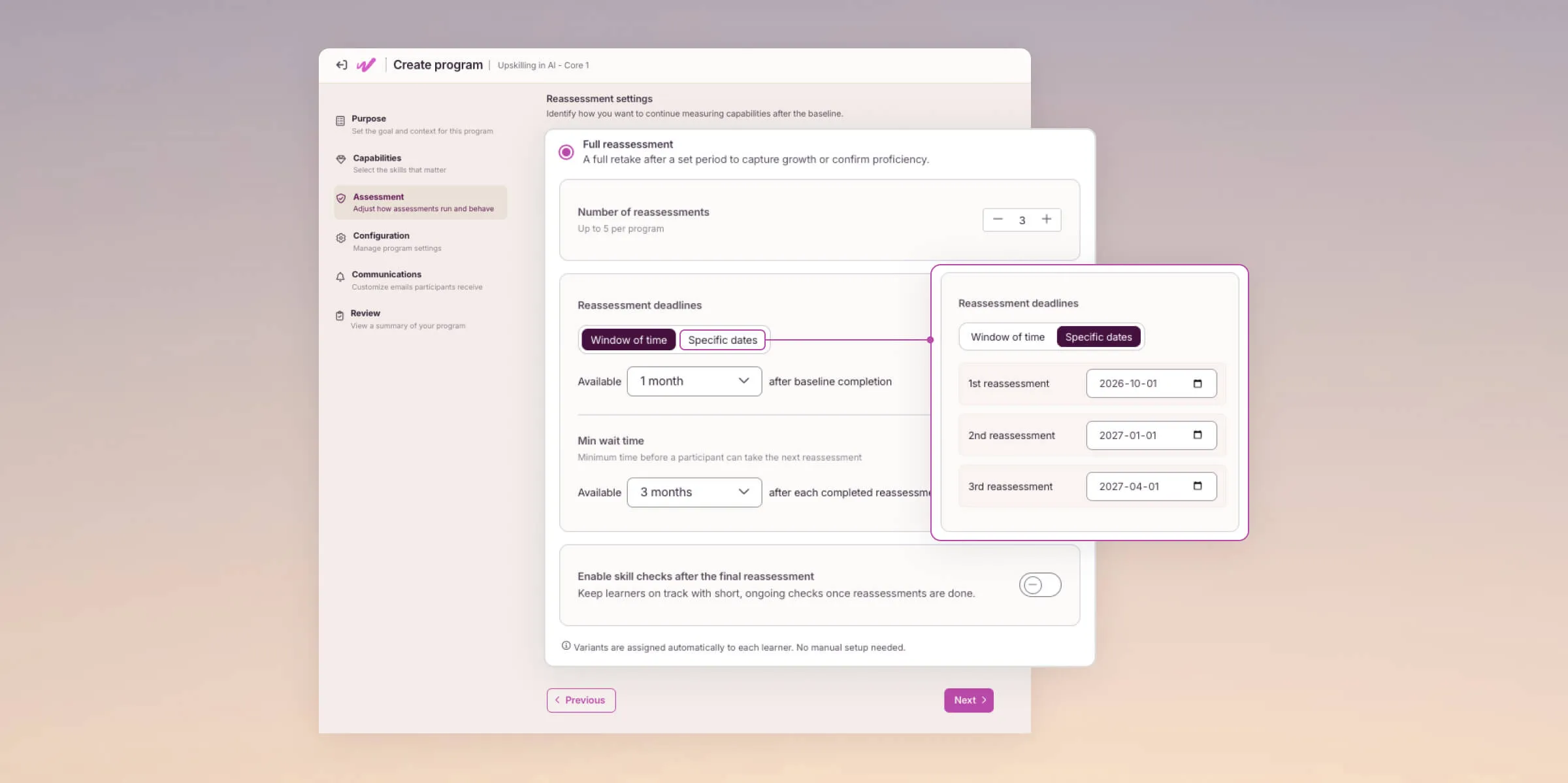
Configure. The leader chooses how many attempts a participant gets, on what schedule, and whether variants shuffle across a group. Attempt counts, availability windows, and minimum wait times are enforced by the platform, so measurement is always bounded.
Deliver. Each attempt serves a variant the participant has not seen. Variants generate and translate in the background at launch, so setup stays fast and there is no content team to staff. Eligibility, upcoming attempts, and history are visible to the participant, with reminders sent automatically.
Measure. Measure. Capability scores are tied to the employee and the capability rather than the program, so a measurement taken once can carry forward into a new program. High-stakes hiring programs are the exception. They always begin from a fresh baseline, and a score earned inside one does not carry out to other programs.
Leaders choose the shape that fits the goal: a full reassessment on a new equivalent variant when the point is proving a program worked, a baseline only when a single current read is enough, or short skill checks for a lighter ongoing signal.
One more benefit is worth naming. Cohort shuffle assigns each person a different but equally rigorous variant when a large group is measured at the same time, which removes the value of a shared answer key rather than policing it afterward. It works alongside proctoring, which is configured separately.
Why a single baseline is no longer enough
A one-time measurement was defensible when roles held still. They do not anymore. LinkedIn's Work Change Report projects that 70% of the skills used in most jobs will change by 2030, with AI as the catalyst. PwC's 2025 Global AI Jobs Barometer, built on close to a billion job advertisements, found that the skills employers seek are changing 66% faster in the occupations most exposed to AI, up from 25% the year before.
A baseline taken last year is describing a job that no longer exists. Readiness is not a snapshot to be filed. It is a number leaders need to watch move, cycle after cycle, on evidence that holds up each time.
Repeat measurement also does something useful on its own. Decades of research on retrieval practice show that being asked to recall material strengthens retention more than reviewing it again does — one more reason a second measurement isn't neutral.
The honest number
A participant's current proficiency reflects their highest achieved score to date; that number doesn't drop because of a reassessment, by design. What does stay visible is the full record: every attempt, every score, retained and shown in the participant's history rather than smoothed over.
Reassessment is built for the moment someone asks how you know a program worked, and to have an answer that holds up.
Ready to see it? Request a demo today!
Category
Product updates
Trending Updates
News
Pearson Agrees to Acquire Workera, a Pioneer in AI-Native Enterprise Assessment and Skills Verification
Product updates
You Bought the Tools. Now You Can See Who Is Ready to Use Them.

Blog
Can You Defend the Growth Number in Your AI Readiness Update?